FOREWORD
A New Economic Era Has Begun
There are moments in economic history when a new technology does more than simply improve existing products. It changes the rules by which companies are created, operate and grow.
Industrialization transformed production.
Electricity transformed industry and society.
The automobile transformed mobility, commerce and cities.
Computers transformed the processing of information.
The Internet transformed communication, commerce and global access to knowledge.
Digitalization increasingly freed data, processes and business models from purely physical structures.
Today, we are witnessing the next stage of this evolution.
Artificial intelligence is beginning not only to process information, but to understand language, generate content, recognize patterns, make predictions, coordinate processes, develop software and – in combination with machines and robotics – increasingly interact with the physical world.
This makes AI far more than a new category of software.
It is evolving into a foundational economic technology.
For investors, this creates an extraordinary situation.
On the one hand, artificial intelligence is already a reality. Companies are using AI in development, manufacturing, analytics, customer service, marketing, logistics, finance, research and many other areas.
On the other hand, the economic application of this technology is still at a comparatively early stage in many sectors.
It is precisely between these two realities that an interesting situation emerges:
The technology is real – but a significant share of its future economic value has yet to be created.
This book is designed to help you understand this development.
It is neither a technical AI course nor a collection of spectacular predictions about the future.
Nor is it intended to suggest that every company using the term “AI” automatically represents a good investment.
Quite the opposite.
The greater the enthusiasm surrounding a new technology, the more important economic understanding, critical analysis and the ability to distinguish technological fascination from a sustainable business model become.
That is why this book does not begin with an investment opportunity.
It begins with knowledge.
First, we will examine what artificial intelligence actually is today and what it can already accomplish economically.
Then we will explore the AI value chain.
We will look at where capital is flowing and why companies, governments and investors are committing enormous resources to AI infrastructure, models, automation and applications.
After that, we will address one of the most important questions in this book:
What happens to the economics of a company when intelligent systems can make processes faster, more efficient and more scalable?
Building on that foundation, we will examine speed, competition and the critical gap between a good idea and successful commercial execution.
We will then consider different ways to finance companies, accelerate growth and access capital markets.
Only much later will our general analysis become a specific one.
Because knowledge should precede an investment decision – not follow it.
The purpose of this book is not to tell you what to think or where to invest.
It is designed to provide you with the context required to ask the decisive questions yourself.
For the forward-thinking investor, the most important question is not:
“What is popular today?”
It is:
“Which structural changes will shape tomorrow’s economy – and where can sustainable economic value emerge from them?”
Mario Eduard Giovanelli
INTRODUCTION
Welcome to a New Economic Era
If you follow developments in artificial intelligence today, you encounter new announcements almost every day.
New models.
New applications.
New companies.
New billion-dollar investments.
New possibilities.
At the same time, there are warnings about risks, changes in employment, data privacy, cybersecurity, regulation and a pace of technological development that is extraordinary even for experts.
This combination of enormous opportunities and genuine challenges makes AI difficult to assess from an economic perspective.
That is precisely why this Investor Guide was created.
Not to present you with the next supposed miracle investment.
Not to sell artificial intelligence as a short-term trend.
And not to create the impression that the use of AI alone is enough to build a successful company.
The starting point is much simpler:
Understand first. Evaluate second. Decide only then.
AI Is More Than the Next Generation of Software
AI is increasingly changing the way companies develop, analyze, decide, communicate, manufacture, sell and scale.
Tasks that once required specialized teams, significant budgets and long development cycles can, in some cases, now be performed within entirely new time and cost structures.
Software can be developed faster.
Large volumes of data can be analyzed in a fraction of the time.
Customer communication can be automated while becoming more personalized.
Production processes can be monitored and optimized.
Forecasts can be updated continuously.
Knowledge can be made available throughout an organization far more quickly.
And AI itself can assist in the development of new AI systems.
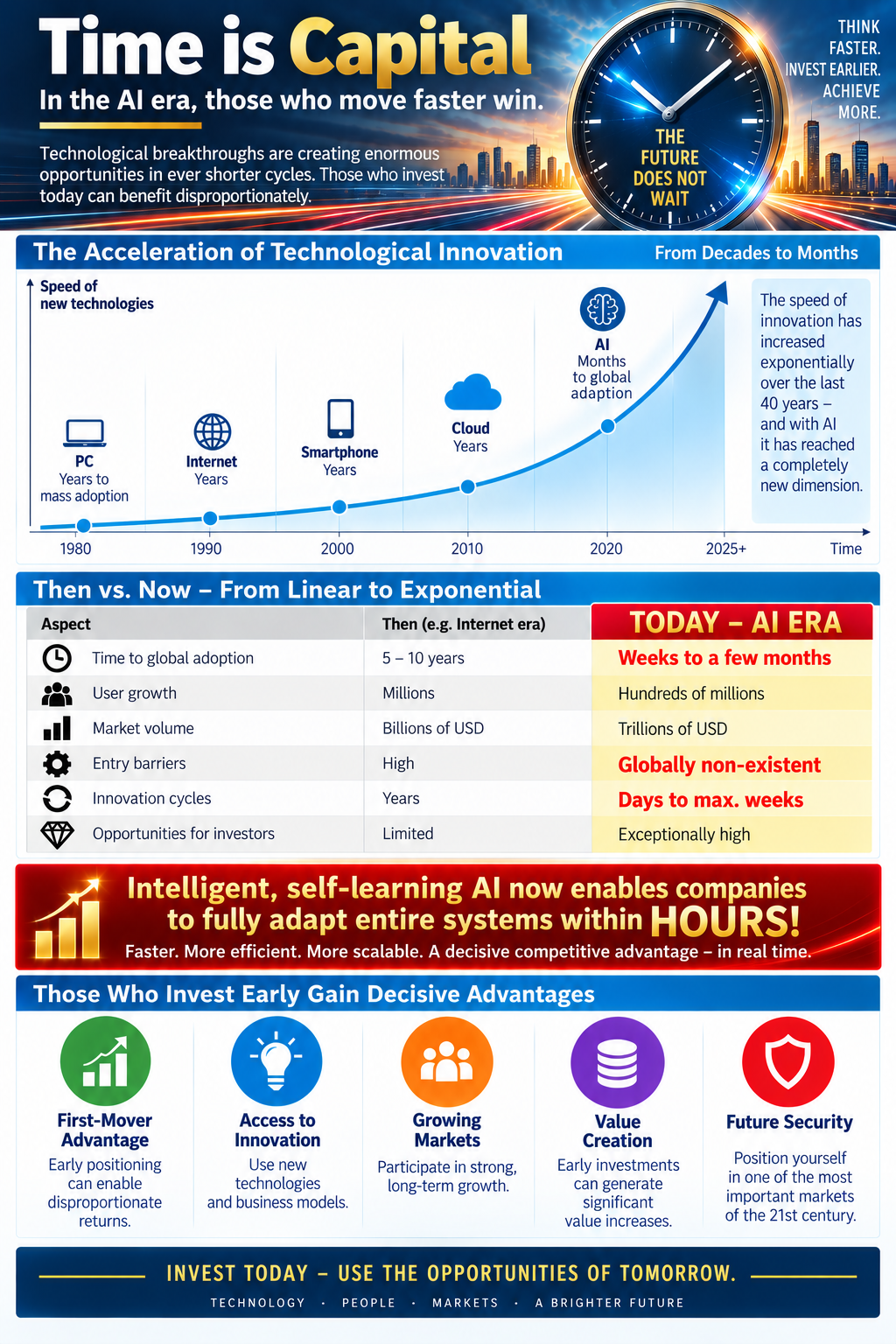
This creates a technological acceleration cycle:
Faster development → faster market entry → more competition → greater pressure to innovate → even faster development.
AI therefore does not merely accelerate companies.
AI increasingly accelerates competition itself.
Technology Alone Does Not Create a Good Investment
None of this means that every AI idea automatically becomes a good business.
A company still needs a real problem to solve.
It needs customers.
A viable business model.
Management.
Capital.
Market access.
And the ability to execute its solution better, faster or more economically than its competitors.
For investors, therefore, the decisive question is not how often the term “AI” appears in a company presentation.
The relevant questions are different:
What specific problem is being solved?
Why is AI suitable for solving it?
What economic improvement can it create?
Is there a relevant market?
How does the company make money?
Can the business model scale?
Who are the competitors?
What risks exist?
And does the company have the resources and capabilities to execute its strategy?
There is therefore a substantial gap between a good idea and a successful company.
We will devote an entire chapter to that gap later.
Opportunities and Risks Belong Together
A serious analysis of artificial intelligence must not ignore risk.
AI systems can produce errors.
Data can be incomplete or biased.
Automated decisions may require controls, depending on the application.
Data privacy and cybersecurity become increasingly important.
Companies can become dependent on individual technology or infrastructure providers.
Regulatory requirements may change.
And because AI accelerates development, successful business models may attract competitors faster than before.
But risk is not an argument against innovation.
It is a management responsibility.
Professional companies address these risks through appropriate data strategies, security architectures, control mechanisms, compliance, diversification of technological dependencies and clearly defined responsibilities.
For investors, therefore, the decisive question is not whether a company has risks.
Every company has risks.
The decisive question is:
Does management understand those risks – and does it have a convincing strategy for managing them?
The Investor’s Perspective
If AI genuinely changes cost structures, productivity, speed and scalability, it inevitably changes the way companies are economically assessed.
A company that must increase its costs almost proportionally in order to grow has a different economic structure from one that can process a substantial share of additional business through scalable digital systems.
A company that requires twelve months to develop a new product operates in a different competitive environment from one that can significantly shorten development and testing cycles.
And a company whose knowledge is fragmented across individuals and departments has different capabilities from one that can intelligently access and distribute that knowledge throughout the organization.
This does not mean that AI automatically makes traditional companies superior or obsolete.
It means that productivity, speed and scalability can be redefined through AI.
That is precisely where its economic significance lies.
What This Book Will Show You
We will therefore proceed step by step.
First, we understand AI.
Then we examine the markets.
We follow the capital.
We investigate why AI can change the economics of companies.
We examine the importance of timing.
We look at the difference between an idea and successful execution.
We explore financing, growth and capital-market strategies.
And only after these foundations have been established will we turn to specific companies, projects and investment opportunities.
The reason is simple:
You should not find an investment opportunity attractive simply because someone tells you that it is attractive.
You should be able to determine for yourself whether a strategy is based on comprehensible economic developments.
This first section is therefore deliberately available free of charge.
It allows you to decide whether you want to explore the economic dimension of artificial intelligence in greater depth.
If you continue reading, the in-depth section of this Investor Guide begins.
And it starts with a fundamental question:
What is artificial intelligence actually capable of today – and what can it already achieve economically?
TABLE OF CONTENTS
FOREWORD
A New Economic Era Has Begun
INTRODUCTION
Welcome to the New Economic Era
Understand first. Evaluate second. Decide only then.
AI Is More Than the Next Generation of Software
Technology Alone Does Not Create a Good Investment
Opportunities and Risks Belong Together
The Investor’s Perspective
What This Book Will Show You
What is artificial intelligence actually capable of today – and what can it already achieve economically?
CHAPTER I
WHAT ARTIFICIAL INTELLIGENCE CAN REALLY DO TODAY
The Chatbot Is Not the Revolution
What Do We Mean by Artificial Intelligence?
Generative Artificial Intelligence
Predictive Artificial Intelligence
Computer Vision
Voice and Speech AI
Autonomous AI Systems
Robotics and Autonomous Systems
AI Develops Software - and Accelerates Digitalization
From an Individual Tool to an Intelligent Company
The Decisive Variable Is Productivity
How much more economic output can a company generate with its existing or more strategically deployed resources?
AI Is Not a Substitute for a Business Model
Behind Every AI Application Is a Value Chain
Tomorrow Is Already TODAY – When Artificial Intelligence Begins to Accelerate Its Own Development
What Is Already Being Developed Today
And This Is Already Giving Rise to the Next Stage of Development
Back to Business Reality – the Decisive Factor Is Productivity
AI Is Not a Substitute for a Business Model
Behind Every AI Application Is a Value Chain
Where within this ecosystem is economic value being created?
CHAPTER II
THE ARTIFICIAL INTELLIGENCE VALUE LANDSCAPE
AI Is a Value Chain
Chips - The Physical Foundation
Data Centers - The Factories of the Digital Economy
Cloud - Computing Power as a Service
Foundation Models - General AI Capabilities as a Platform
AI Infrastructure - The Connecting Layer
Applications - Where AI Meets the User
Specialized Industry AI
Where Is the Most Interesting Investment Opportunity?
Who is investing - and why?
CHAPTER III
FOLLOW THE MONEY
Capital Is a Signal
Why is capital being invested in which areas?
Major Technology Companies Invest in Infrastructure
Governments Recognize AI as Strategic Infrastructure
Venture Capital Searches for the Next Generation of Companies
Private Equity Looks at AI Differently
Strategic Investors Buy More Than Returns
Billions of Dollars Are Not the Real Message
Capital is being positioned across the entire AI value chain.
The Decisive Change in Perspective
CHAPTER IV
THE AI PRODUCTIVITY SHIFT
Why Artificial Intelligence Can Change the Economics of a Company
Which of these two companies would you want to examine more closely as an investor?
Less Repetitive Work
How much additional output can be generated with the same resources?
Lower Administrative Overhead
Speed Is an Economic Factor
Error Costs and Prevention
Knowledge Becomes Scalable
Customer Service Can Become More Scalable
Now Imagine You Were the Capital Provider
How much additional economic output can each invested euro generate?
Imagine You Were the Bank
AI Can Affect Both Sides of the Profit Equation
What Does This Mean for Investors?
Potential is not yet performance.
The New Investment Question
How much of my capital should remain completely untouched by the AI-driven transformation of the economy?
technological transformation cutting across almost every existing investment class.
The Risk of Doing Nothing
Those Who Understand Early Can Select Earlier
Which trains are actually heading in the right direction?
Why now?
CHAPTER V
WHY NOW?
The AI Investment Window
Is AI Still the Future?
AI is already economically usable – while its economic penetration is still far from complete.
Development Costs Can Decline
The Cost of Experimentation Falls
Speed Changes Competition
The Acceleration Cycle
Early Mover Does Not Automatically Mean First Mover
Data and Experience Can Create an Advantage
The Investment Window Does Not Close Tomorrow
The opportunity does not disappear tomorrow - but the cost of entering late can increase over time.
The Real Question Is Therefore
Which stage of the economic transformation are we in – and which opportunities are particularly interesting at this stage?
CHAPTER VI
THE GAP BETWEEN AN IDEA AND SUCCESSFUL EXECUTION
Good Ideas Are Not the Scarcest Resource
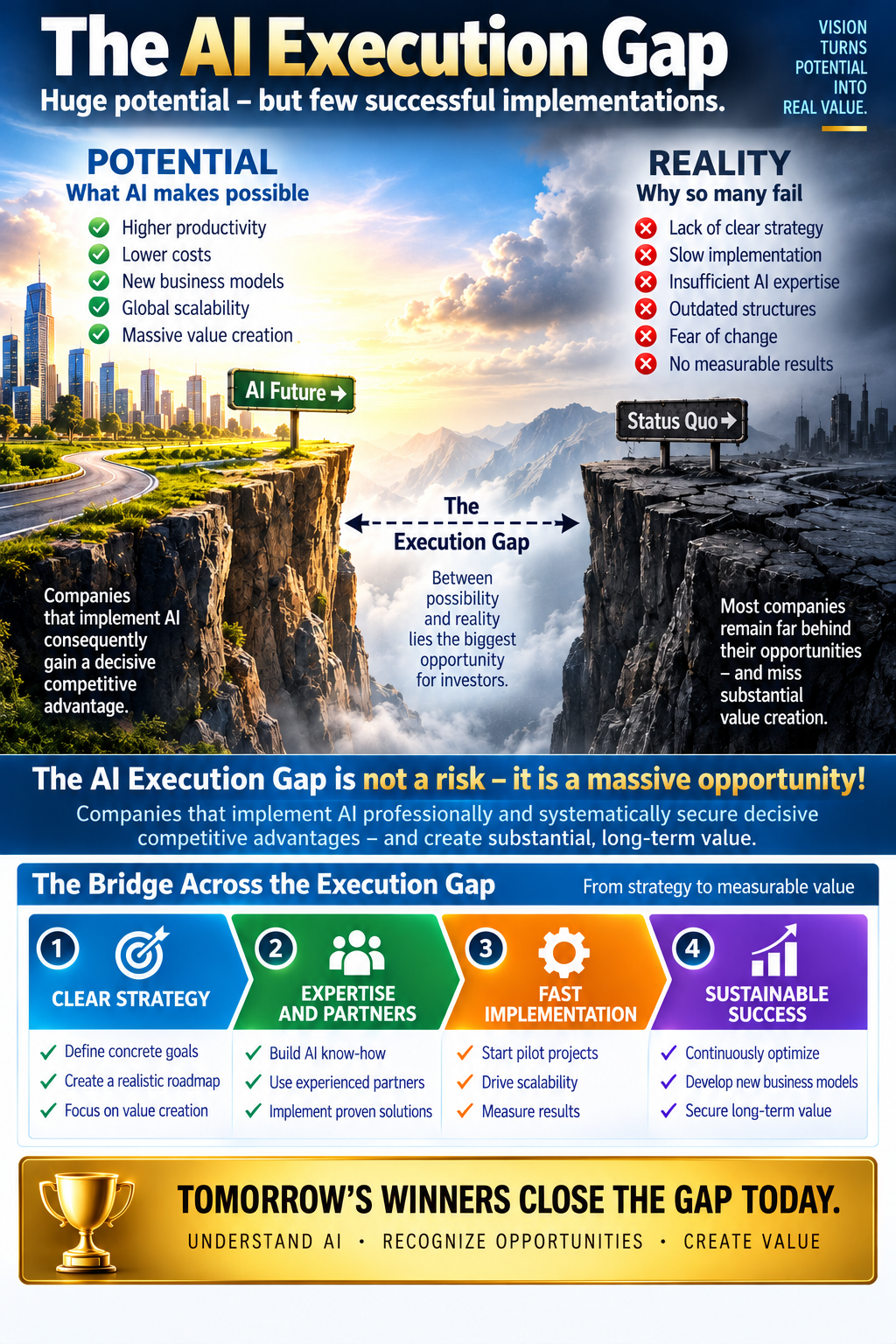
The AI Execution Gap
THE IDEA
THE SUCCESSFUL, SCALABLE COMPANY
Capital
Technology
Management
Speed
Speed + Direction + Control.
Market Access
Scalability
The Bridge Must Be Complete
The Better Investment Question
execution capability.
CHAPTER VII
SPEED TO MARKET
From an Idea to a Scalable Company
Speed Requires Capital
Bootstrapping - Maximum Control, Limited Speed
Venture Capital - Growth in Exchange for Equity
Private Equity - Capital Plus Structure
Strategic Investors
The Traditional Initial Public Offering
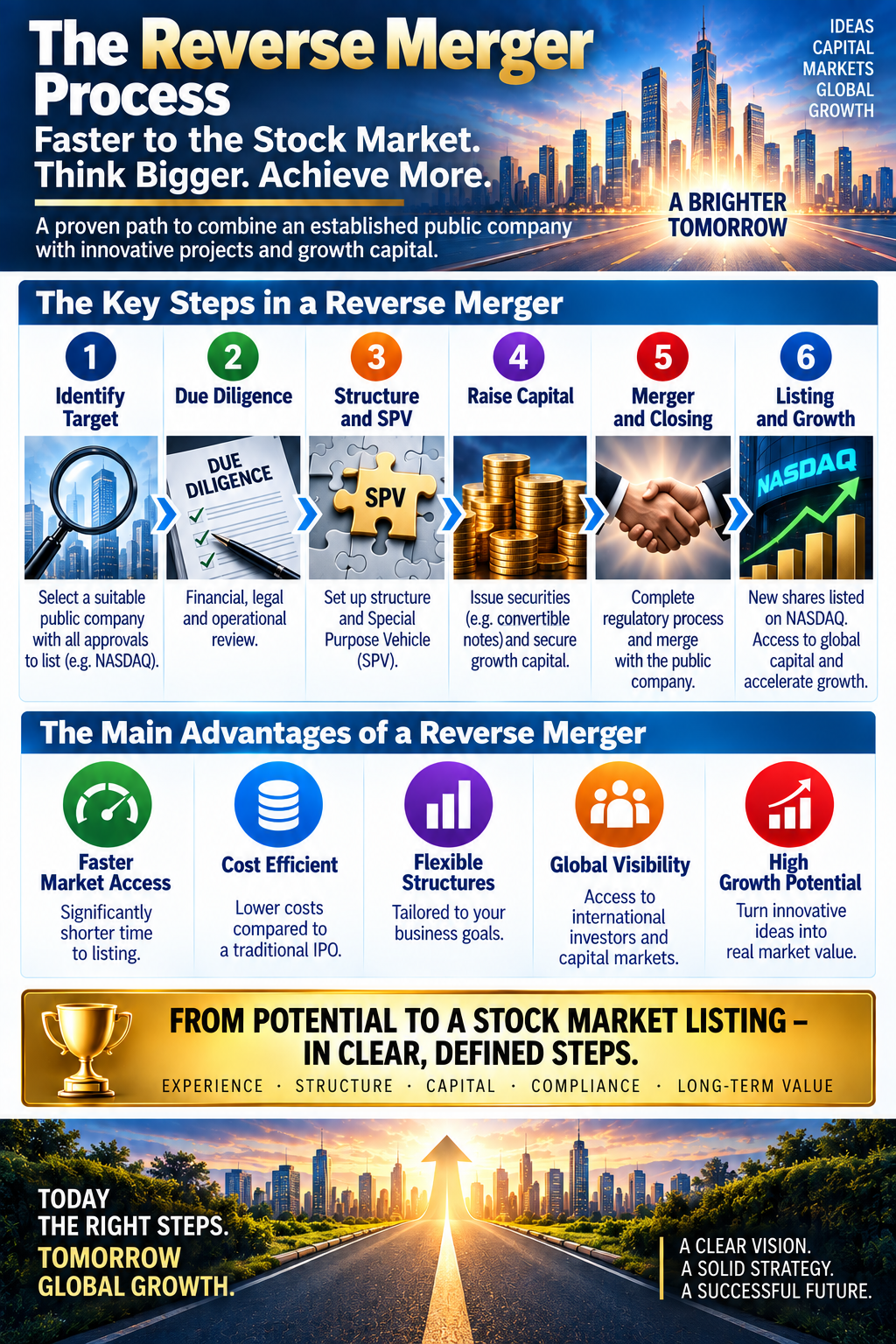
Public-Shell Transactions and Reverse Mergers
CHAPTER VIII
THE REVERSE MERGER AS A CAPITAL-MARKET STRATEGY
What Is a Reverse Merger?
Why Do Companies Choose This Route?
Which capital-market route best fits the specific corporate strategy?
The Role of Preparation
Bridge Financing
Convertible Bridge Notes
Why Can a Bridge Structure Be Strategically Interesting?
A Public Listing Is Not Corporate Success
We build economic substance - and use the capital markets to scale that substance more rapidly.
The Capital Market as an Accelerator
How can such a strategy be put into practice?
CHAPTER IX
FROM THEORY TO PRACTICE
When an Insight Becomes an Entrepreneurial Strategy
One Question Became Increasingly Important to Me
How would we build a company today if, instead of digitalizing the structures of the past, we wanted to use the possibilities of the future from the very beginning?
Not Just One AI Project
…systematic development of proprietary AI-based companies and projects.
Why Multiple Projects?
This Is Precisely Why My U.S. Holding Company Exists
HEBHI - Human Ecological Business International Inc.
Develop. Build. Scale. Monetize.
AI-based company and project platform.
CHAPTER X
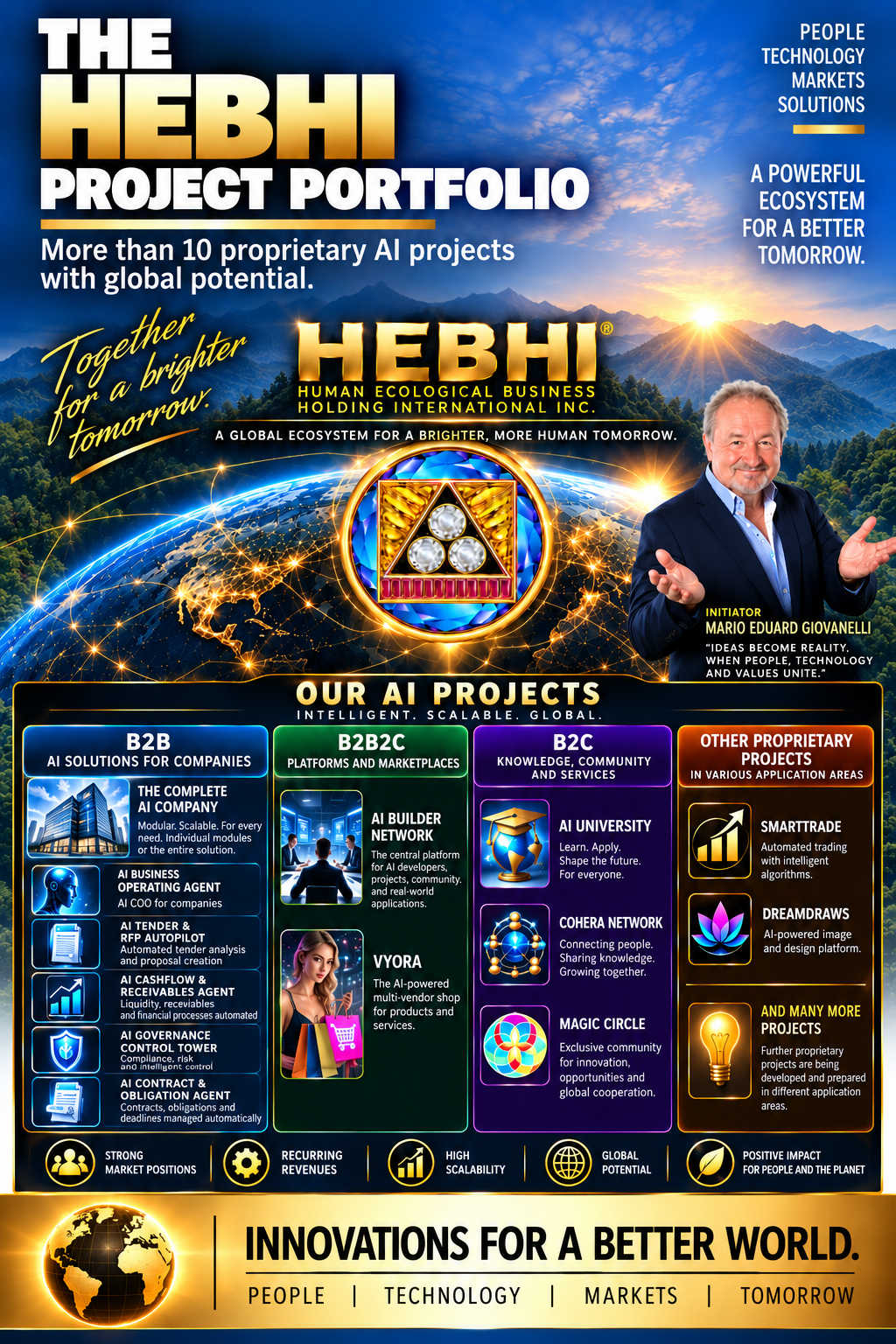
THE PROJECT PORTFOLIO
From Strategy to Practical Applications
B2B
THE COMPLETE AI COMPANY
From Individual AI Tools to a Modular, Largely Autonomous Business Organization
A Modular Business Model Instead of a Rigid All-in-One Package
Already Being Implemented in Parallel
The First Five Near-Market B2B Products
1. AI BUSINESS OPERATING AGENT – AI COO FOR COMPANIES
2. AI TENDER & RFP AUTOPILOT
3. AI CASHFLOW & RECEIVABLES AGENT
4. AI GOVERNANCE CONTROL TOWER
5. AI CONTRACT & OBLIGATION AGENT
Five Products – One Shared Platform Logic
Economic Potential
B2B2C
AI BUILDER NETWORK
VYORA
B2C
AI UNIVERSITY
COHERA NETWORK
MAGIC CIRCLE
Other Proprietary Projects
SMARTTRADE
DREAMDRAWS
The Portfolio Effect
Source Notes for the Market Indicators Mentioned Above
CHAPTER XI
FROM PROJECT PORTFOLIO TO CAPITAL-MARKET STRATEGY
Why Growth Requires Capital
Why Not Rely Exclusively on Traditional Venture Capital?
The Strategic Objective
…a professionally prepared U.S. reverse merger aimed at establishing an appropriate U.S. capital-market structure.
…strategic financing and scaling instrument.
Why the U.S. Capital Market?
Capital Should Enable Growth
But the Route There Must First Be Financed
CHAPTER XII
THE INVESTMENT OPPORTUNITY
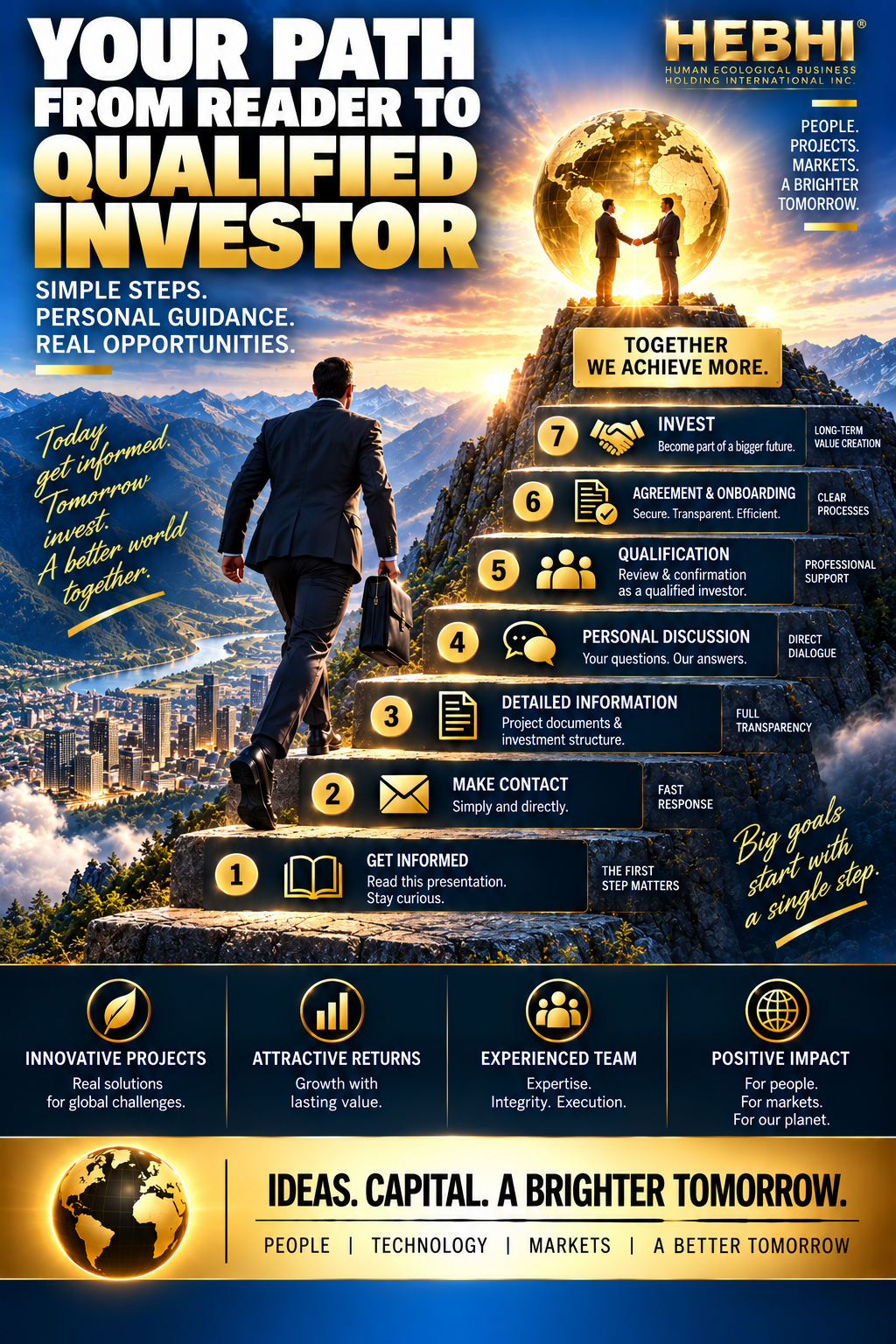
From Information to Decision
Purpose of the Financing
The Planned Bridge Financing
Why Convertible Bridge Notes?
This book is never the governing document - only the final legal investment and contractual documentation is binding.
The Investment Case
THE OPPORTUNITY
THE CONDITIONS AND RISKS UNDER WHICH THAT OPPORTUNITY COULD BE REALIZED.
What an Investor Should Actually Evaluate
CHAPTER XIII
OPPORTUNITY AND RISK
No Professional Investment Without Risk Analysis
Transaction Risk
How This Risk Can Be Addressed
Development Risk
How This Risk Can Be Addressed
Market Risk
How This Risk Can Be Addressed
Concentration Risk
How This Risk Can Be Addressed
Financing Risk
How This Risk Can Be Addressed
Regulatory Risk
How This Risk Can Be Addressed
The Objective Is Not Zero Risk
Do I understand the risk – and is it acceptable to me in relation to the potential opportunity?
CHAPTER XIV
THE QUALIFIED INVESTOR
Not Every Investment Is Suitable for Every Person
The Most Important Questions Before Making a Decision
Can I financially absorb a possible loss?
Professional Investors Ask Difficult Questions
CHAPTER XV
DUE DILIGENCE - VERIFY, DON’T JUST BELIEVE
Trust Matters. Verification Matters More.
What Should an Investor Examine?
KAPITEL XVI
THE INVESTOR ROOM
From Reader to Evaluating Investor
Then Comes the Human Conversation
…the personal conversation.
FINAL CHAPTER
INVESTING IN AN ECONOMY THAT IS CHANGING BEFORE OUR EYES
…the amount of output that can be generated from a given amount of time, labor and capital.
The Most Important Ability of an Investor
AI Does Not Require Blind Enthusiasm
Do not ignore AI.
The Future Will Not Be Decided in a Single Day
Those who understand earlier can select more carefully.
Understand early. Examine carefully. Decide consciously.
ABOUT THE AUTHOR
MARIO EDUARD GIOVANELLI
The most interesting companies of the coming economic era will not emerge solely by adding AI to existing business models. Some will emerge because AI makes business models possible that previously could not have been economically viable.
FINAL NOTICE
APPENDIX
THE PROFESSIONALS
THE SPECIALISTS AND PARTNERS
THE REFERENCE TRANSACTIONS
THE BASIC MODEL
← Read less